Using Cooperative Care and the Premack Principle to Help Your Pet Become Comfortable with Eye Drops
By Don Hanson, PCBC-A, BFRAP
< A version of this article was published on the Green Acres Kennel Shop blog >
< A version of this article was published in the November 2022 issue of Downeast Dog News>
< A version of this article was published in Pets and Their People on November 29, 2023 >
< Updated 2026-10-19 >
< The link to this page – https://www.forcefreepets.com/cooperative-care-eyedrops/ >
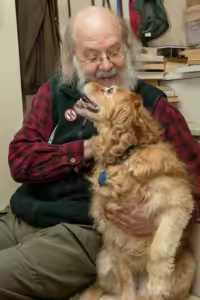 In the Spring of 2022, Muppy saw an eye specialist and was prescribed eye drops she would need every morning. Dr. Blackwood explained that one of the drops
might sting and could make Muppy less cooperative. On day two, Muppy started hiding to avoid her drops. Since this would be a daily event, probably for the rest of her life, I was very concerned about how it could damage our bond.
If you think back to your childhood, you probably remember your mom telling you that you wouldn’t get dessert if you didn’t clean your plate. I remember an uncle taking me fishing and telling me I had to eat my bread crust before we could go down to the boat. Adults use this tactic in their personal and business lives, too. When doing so, we are using a promise of a more desirable activity, eating dessert, as an incentive for completing a less desirable behavior: eating cooked spinach. It works! We do this because it works! This behavior modification technique is called the Premack Principle. [ FMI – https://www.simplypsychology.org/premack-principle.html ]
My first step was to find a highly reinforcing behavior for Muppy that could be the reward for allowing me to administer her eye drops. One of Muppy’s greatest joys is mealtime. This is how I incorporated Muppy’s eye-drop administration into her morning routine. Each step follows the other.
- Go outside for her morning bathroom break
- Administer the eye drops.
- Breakfast!
I started administering eye drops in the kitchen, next to the counter where I prep Muppy’s food. She was on the floor, so I had to bend over, something dogs find confrontational, and my back didn’t appreciate it either. Muppy also quickly learned she could wiggle around the kitchen floor, which made the process frustrating for both of us. She was getting her drops and breakfast, but it was still something she tried to avoid.
Then one day, I noticed something interesting. An intermediate step existed between coming in from outdoors and going into the kitchen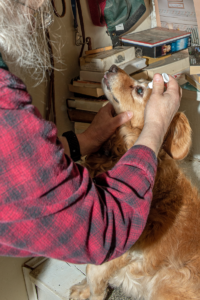 to administer the drops. Muppy reliably defecates almost every morning. That means I return to the house with a full poop bag that I need to take out to the poop receptacle. The door I go out is next to the stairs leading to the second floor. While I went out, Muppy would typically sit on the third step up from the floor and wait for me before we both went into the kitchen. That triggered an idea.
Trainers in zoos and other settings with large captive animals train them to “station” so they can perform necessary medical procedures. I saw this in action while attending an advanced animal training class at the Shedd Aquarium in Chicago. For example, Beluga Whales are trained to swim and remain on station in front of a target. At the same time, a veterinary technician draws blood from a flipper. At the end of the procedure, the whale was rewarded with a fish. I decided to use the third step on the stairs as a station for Muppy’s eye drops.
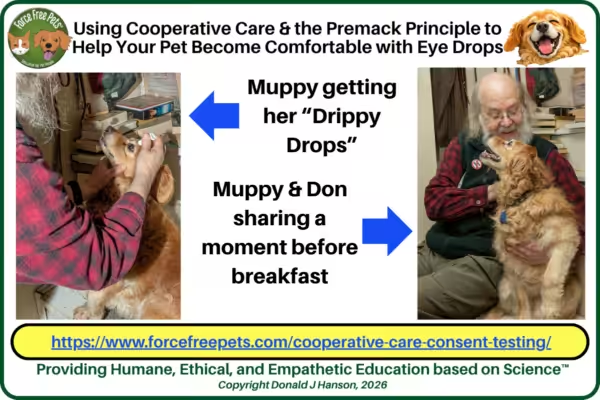
This behavior now has a cue,“Drippy Drops,” which I give Muppy as I get rid of the poop bag. She sits on the step and waits until I’m back, about 3 seconds later. I had the eye-drop bottles prepped on another step, and Muppy sat on the third step, waiting for me. Since she is on the steps, she is less likely to squirm, and it’s easier for me to administer the drops quickly. Also, I don’t have to bend as much because she’s elevated on the third step while I am standing on the floor.
“Drippy Drops” became a routine behavior for us. I often did not need to give the verbal cue as Muppy automatically hopped up on the third step, stationed herself, and waited. She had learned that getting the eye drops meant she would get the meal she craved.
As our pets age, many may require medication regularly. Sometimes the medicine tastes like a yummy treat, and our pets take it without hesitation. However, as in Muppy’s case, her drops caused a little sting. You can modify the routine I’ve outlined here for several similar situations. If you are unsure of how to do so, look for a force-free trainer. You can find many such individuals at: https://www.petprofessionalguild.com/find-a-ppg-professional/.
Eventually, Muppy no longer needed her eye drops. However, this routine had become so strong because it was ALWAYS rewarded. Even though she no longer needed eye drops, she’d fly to the third step and sit there, waiting for me to ask if she wanted her breakfast.
