Why ‘Pet Parent’ is an Appropriate Description of Our Role in Our Dog’s Life
By Don Hanson, PCBC-A, BFRAP
< A version of this article was published in the JUL25 issue of Downeast Dog News>
< Updated 2025-08-01 >
< The link to this page – https://www.forcefreepets.com/PetParent-Kahu/ >
How we describe our relationship with our dog matters because, consciously or subconsciously, it affects how we treat them. While some pet care professionals and people cringe at the term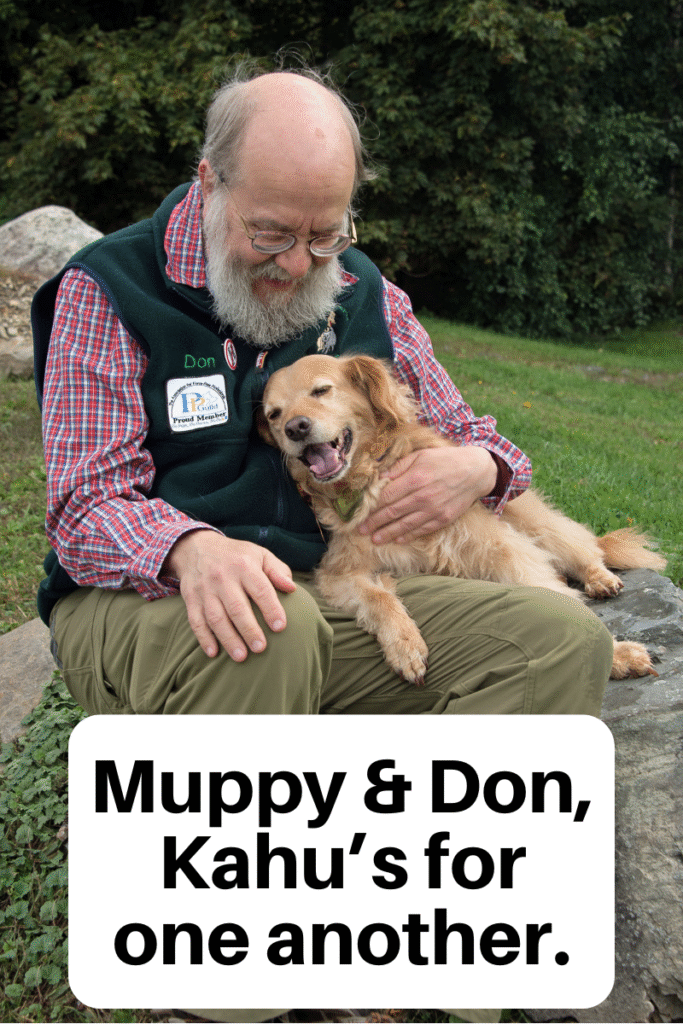 “pet parent,” I believe it is an accurate and appropriate description, demonstrating that our dog is part of the family.
In the US, the law usually tells us our dog is nothing more than property. Classifying our dogs as property is tantamount to endorsing their abuse, as happened when humans were legally no more than property. The term “pet parent” also implies we have a much greater responsibility to our dog than if they were a mere piece of property like the sofa in our living room. Unfortunately, too many people still have a dog but do not take the responsibility seriously.
We also need to understand that a human child and a dog are two different species with very different physical and emotional needs and methods of communicating and learning. In other words, being a great parent to a human does not automatically make you a great parent to a dog, nor does being a fantastic dog parent mean you will be amazing at parenting a child. However, if you take the time to learn and meet your child’s or dog’s basic needs, methods of communication, and learning, and are naturally empathetic, compassionate, and patient, you will likely do well.
There is one big difference between the development of a human child and a dog that we must never forget. Most children will typically develop into responsible adults. However, neuroscientists agree that at best, dogs usually grow to be cognitively and emotionally equivalent to a 2—to 2.5-year-old child. A toddler requires a great deal of nurturing care during this period; however, your dog will need that same level of care for their entire life. Make sure you understand and are willing and able to make that commitment.
Things in our dog’s life we are responsible for include:
- Understanding Their Special Needs—Dogs are not humans and have particular needs that must be met. They have developmental schedules with timelines, and they communicate very differently. However, they can easily see the difference between a friendly and angry human face and detect our emotions from our scent. Dogs, like children, can also form powerful attachment bonds to the humans in their family. Interestingly, brain imaging studies of people and their dogs have indicated increased levels of the hormone oxytocin in both human and dog brains when the two species have positive interactions. This is the same hormone responsible for the bonding between an adult human and a human child. While dogs learn similarly to humans in many ways, you must understand the fundamentals of training that apply to a dog. While you can obtain this knowledge online and from books, be aware that many of those sources may be outdated. The best way to learn what you need to know is from an accredited Professional Canine Trainer (PCT) or Professional Canine Behavior Consultant (PCBC).
- FMI – Helping Your Dog Thrive–Brambell’s Five Freedoms – https://www.forcefreepets.com/brambells-five-freedoms/
- FMI – Find a PPG Training and Behavior Professional – https://www.petprofessionalguild.com/find-a-ppg-professional/
- Physical Health and Well-Being—We must ensure our dog has adequate and appropriate food and water, a comfortable place to live free from the ravages of inclement weather, and proper space for its needs. They must also have adequate physical exercise that they enjoy and that maintains their physical fitness. If your dog is sick, you need to be prepared to take them to the veterinarian as necessary. Dogs must be leashed as necessary and prevented from running off into harm’s way.
- FMI – Our Pets’ Most Important Nutrient–Water – https://www.forcefreepets.com/wateranimportantnutient/
- FMI – Don, what do you feed your dog Muppy? – https://www.forcefreepets.com/donwhatdoyoufeedmuppy/
- FMI – Help! My Dog’s Run Off! – https://www.forcefreepets.com/help-mydogsrunoff/
- Emotional and Mental Health and Wellbeing—We need to protect our dog from emotional trauma as well as physical harm. Dogs are sentient beings, and to thrive, they must have a choice and the right to consent to how others interact with them. That includes other people as well as other pets. Not all dogs will do well with other pets, and that’s okay. Since we control so much of our dogs’ lives, we must provide them with appropriate mental enrichment and choices whenever possible. Walks should be about rambling opportunities to sniff and not about walking the same boring route as fast as possible every day.
- FMI – Pets, Emotions, & Anthropomorphism – https://www.forcefreepets.com/pets-emotions-anthropomorphism/
- FMI – How Your Dog Can Tell How You Feel & How It Affects Their Behavior – https://www.forcefreepets.com/how-your-dog-can-tell-how-you-feel/
- FMI – The Art and Science of Consent Testing – https://www.petprofessionalguild.com/barks/barks-magazine-blog/the-art-and-science-of-consent-testing/
- FMI – How Do I Get My Dog to Like Other Dogs, or Do All Dogs Need A Doggie Friend? – https://www.forcefreepets.com/how-do-i-get-my-dog-to-like-other-dogs/
- FMI – Walking the Dog–Please Make It Enjoyable for Your Dog! – https://www.forcefreepets.com/walking-the-dog-please-make-it-enjoyable/
If you consider your dog a beloved family member, and I sincerely hope that you do, please treat them with the same care as you would a human toddler throughout their entire life.
UPDATE: Since initially writing this article in June of 2025, I have seen several memes on Facebook citing the Hawaiian word “Kahu” or “Ka-Hu” 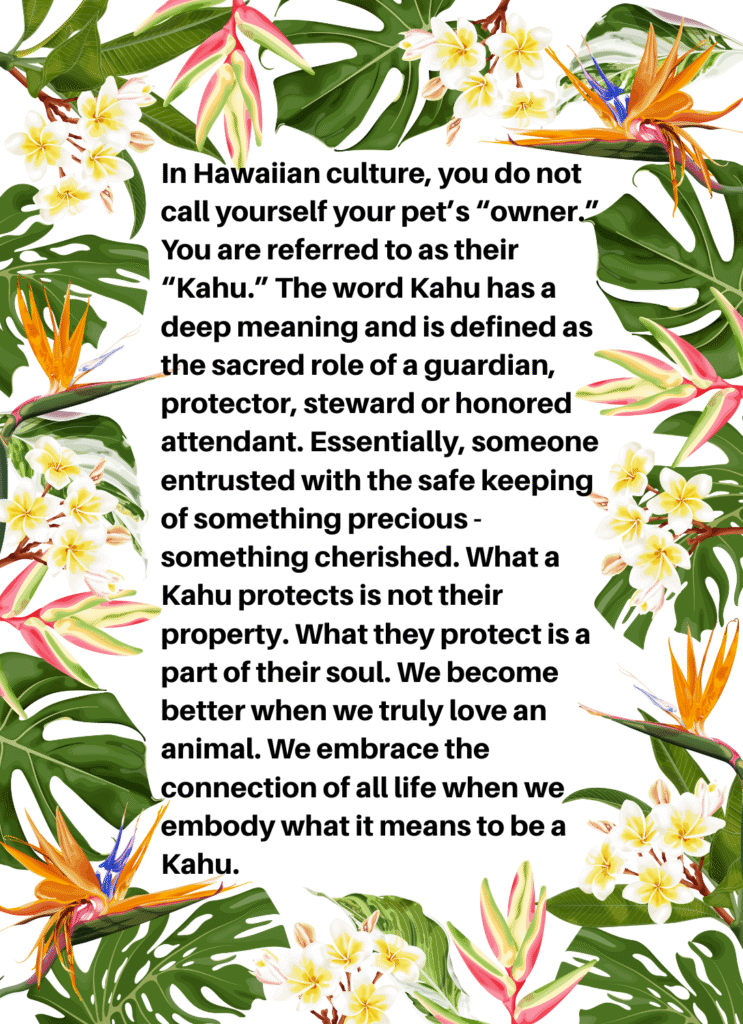 in reference to a person’s relationship to their pet. For example: “The word Kahu has a deep meaning and is defined as the sacred role of a guardian, protector, steward, or honored attendant. Essentially, someone entrusted with the safe keeping of something precious – something cherished. What a Kahu protects is not their property. What they protect is a part of their soul.” – from Facebook
Two Hawaiian dictionaries online ( https://wehewehe.org/ ) define these words as follows:
- Ka-hu: an upper servant, a guardian, a nurse, a feeder, a keeper; kahu hipa, a shepherd, a servant. – Andrews (1836)
- Kahu: Honored attendant, guardian, nurse, keeper of ʻunihipili bones, regent, keeper, administrator, warden, caretaker, master, mistress; pastor, minister, reverend, or preacher of a church; one who has a dog, cat, pig, or other pet. According to J. S. Emerson, 92:2, kahu “implies the most intimate and confidential relations between the god and its guardian or keeper. – Hawaiian Dictionary (1986)
While I could find no direct evidence that Hawaiian culture has traditionally used the word Kahu in place of “dog owner” or “pet parent”, the concept of a person being a steward rather than the owner of an animal is found in many Pacific Islander cultures, I do agree with this sentiment.
